
Growing Venus flytraps from seed is a must for any Venus flytrap enthusiast!
Venus Flytrap Seeds are easy to germinate and grow provided a few conditions are met for optimal germination and initial growth. We will discuss these conditions and techniques below in details.
In the northern hemisphere, the Venus Flytrap flowering and seed-producing season are generally about April to June. So by late June or early July fresh new seed should be available. When stored properly in a refrigerator, seeds will germinate great for at least a year after harvest. Many people report high germination rates even after several years in storage.
Buy Venus Flytrap seed at the FlytrapStore
Germination of Venus Flytrap Seeds
Step-by-Step Instructions for growing Venus flytraps from seeds:
- Start by preparing your “soil.” Use the same soil that is the growing medium for adult Venus flytraps. We recommend peat moss mixed with silica sand at a 1:1 ratio by volume. Perlite can be added as well but ensure that the pieces are quite small. Alternatively, long-fibered sphagnum works well. Do not use soil with other ingredients added, such fertilizer. No “potting soil” and no Miracle-Gro because they contain minerals that will kill Venus flytraps. It is highly recommended that, whatever soil you choose, you sterilize the soil before sowing the seeds. This will prevent mold and algae growth, at least until it is reintroduced to the soil. We use a pressure cooker for sterilizing our soil by placing a large bowl of soil (enough to fill whatever pot we will use) in the pressure cooker and running it for 30 minutes once it reaches pressure. More information on sterilizing soil can be found here:
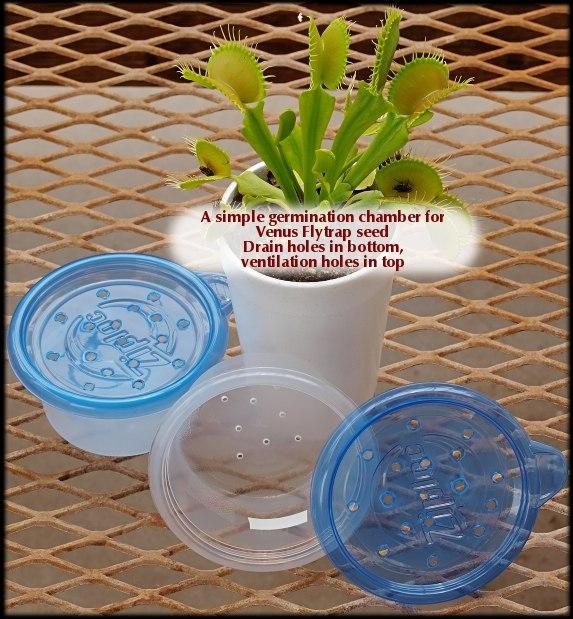
https://www.gardeningknowhow.com/garden-how-to/soil-fertilizers/sterilizing-soil.htm - Next, prepare a growing container. This container keeps the seeds moist and warm but should allow for air circulation. A good easy choice is a Tupperware-type container. Poke holes in the top cover for airflow, and also the bottom portion for drainage. The holes in the lid provide ventilation for air circulation. They also allow for excess heat to escape from inside the container (see above photo). Another option is to use any regular pot or planting container and cover the top with a clear plastic bag.
- Moisten the growing medium with Distilled Water and place the growing medium into the container. Now you are ready to plant the seeds!
- Do NOT bury the seeds. Do not plant seeds underground. Instead, scatter the seeds on top of the moist growing medium. Then sift a very fine dust of sphagnum peat moss over the seeds. The very light dusting helps to retain moisture near the seed. It also helps keep the emerging root from drying out and becoming calloused and stunted. It further gives the seed something to push against as the root emerges and seeks to dig itself into the soil. However, the seeds should only be very lightly covered. Only cover the seeds the point where you can still see them through the dusting. Cover them too much and they may not germinate. If you can no longer see the seed after dusting them with the sphagnum peat moss, that’s too much of a dusting!
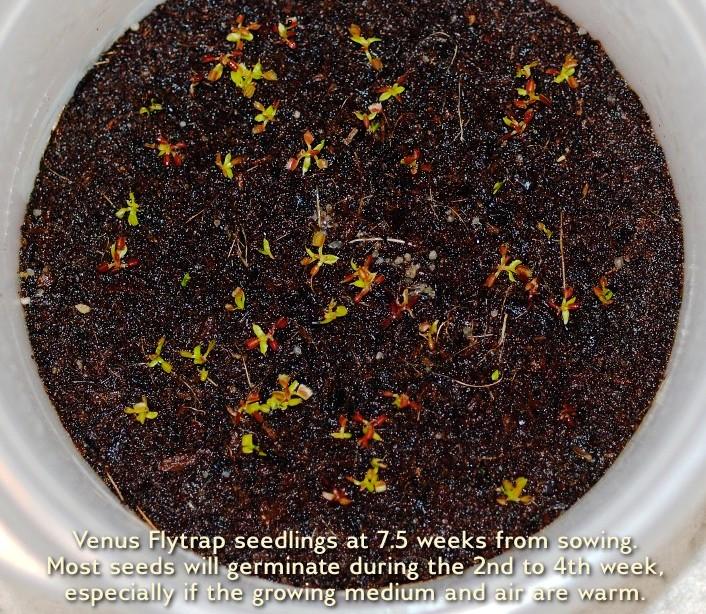
- Spray Distilled water on the dusting of peat moss to moisten it and the seeds. Then cover the container with the vented lid. Germination can take between 10 days and 30 days, depending on conditions. If kept fairly warm, the seeds should begin to germinate in 13-15 days with most of the germination finishing in 20 days, but some stranglers take over a month. Once most of the seeds have germinated, within 4-6 weeks, the covering can be permanently removed.
- Place your germination chamber somewhere with bright indirect light. Do not place the container direct sunlight. This will cause it to overheat both the air and soil inside, which can damage or kill the seeds and germinating plants. Bright indirect light is best. Once most of the seeds have germinated, remove the container cover. Gradually give the seedlings more and more direct sunlight. Grown Venus flytraps require a lot of light, around 3-4 hours a day of good light as a minimum.
- During the germination period of about 13-35 days, keep the growing medium moist and warm. To water the seeds, either a) use a spray bottle to gently wet the soil surface and continue to spray to saturate the medium until some water drains out, or b) place the growing container in a container holding Distilled water, and allow the soil to suck water upward through the drain holes in the bottom of your growing container.
- Ensure that the soil surface is always moist. This allows the newly emerging root to have water to pull from and continue to grow. Use mineral-free water ONLY: Distilled water, reverse-osmosis water, or clean rainwater. Later, when the seedlings are transplanted out of their temporary germination chamber, lower the water content and allow the plants to have more air. Venus flytraps, once they are past the tiny seedling stage, grow very healthy in just-moist rather than soggy or saturated soil. Although, take care to ensure that the soil never completely dries out.
- Keep your growing container humid. This is automatically accomplished by the covering of the container. Though the interior of the chamber should be humid. Lift the lid of the container at least once a day and fan the air. This freshens the air and prevents mold. Though the humidity needs to be higher with newly germinating seeds, your later developed and transplanted Venus flytrap plants do not require higher humidity.
- Keep your growing container at a warm temperature. The optimal temperature to germinate Venus flytraps seeds is above 78 degrees Fahrenheit and up to 90 degrees Fahrenheit (24-32 or more degrees Celsius/Centigrade. Seeds kept at much lower temperatures than this will take longer to germinate (3-5 weeks versus 13-15 days) or may not germinate at all if it is too cold. You can germinate seeds in temperatures somewhat lower than the optimal, but they will take longer to germinate.
- After several weeks of growth, transplant your Venus flytrap seedlings to a more permanent uncovered container. Do the transplant when the “cotyledons” (the two first leaves, the seed leaves) are almost fully extended out of the seed and the first tiny true trap leaf is forming. At this stage, the plant has a base and a tiny root that can be transplanted. The root helps to anchor the plant in its new growing medium. The root also helps it to adapt to conditions of lesser humidity and more light. An easy way to transplant is to use a moist wooden toothpick. Poke a tiny hole in the new and rinsed-of-minerals growing medium for the plant, gently lower the toothpick into the soil near the plant and lift it out of the soil with the root intact, transfer the plant to the tiny hole in its new growing container and gently orient it properly (leaves up, base and root down) then very gently settle it into the new hole with the toothpick a very light touch of a finger, lightly covering in any gaps with growing medium.
FREQUENTLY ASKED QUESTIONS:
- Should I do stratification? — No, not for Venus Flytrap seed. Stratification is the process of keeping seeds cold and damp for several weeks or months, and for Fall-blooming plants, stratification can simulate a winter for the seeds, which are used to germinating the following Spring. But Venus Flytraps bloom in the Spring, not the Fall, and their seeds do not need to be stratified. Instead, Venus Flytrap seeds germinate within days (usually 13-25 days) after they fall to the ground during the summer, the rate and speed of germination increasing with warm temperatures. Therefore, Venus Flytrap seeds should not be stratified, although if they are not sowed immediately they can be stored in the cool refrigerator to help them remain fresh longer and increase germination when sowed at a later date.
- How do I store seeds? — To store excess seed for later germination, place them in a small plastic bag in the refrigerator. Squeeze out the excess air from the plastic bag, to keep the seeds drying out. Keeping them cold helps prevent them from trying to germinate prematurely (warmth stimulates germination) and helps keep them fresh, and keeping them from drying out too much keeps them fresh longer and keeps their germination rate higher. If harvesting your own seed, allow the newly harvested seeds to dry in a small open container for 2-3 days before storage in the refrigerator, to keep them from developing mold (freshly harvested seeds are moister).
- When can I buy Venus flytrap seed? In the northern hemisphere, the Venus Flytrap flowering and seed-producing season is generally about April to June. By late June or early July fresh new seed should be available. If stored appropriately in a refrigerator, Venus flytrap seeds will germinate great for at least a year after harvest. Here is a link to buying Venus flytrap seeds from FlytrapStore.com: Venus flytrap seed at FlytrapStore.com
- How do I pollinate and harvest my own seeds? Unless you plan on harvesting seed, we never recommend letting the flower stalk grow on your Venus flytrap plant, as it will sap a great deal of energy, and the plant will not do very well that year. If you do decide to let the flower stalk grow and bloom, this will typically occur in the Northern Hemisphere anytime between February and May. Flowers are receptive to pollen only 1 to 1.5 days after the flower opens. Pollinate flowers that are receptive with the fresh pollen from a younger flower, preferably one that has just opened.
Seed production in Venus flytraps
To pollinate the flowers, you can use a small artist’s brush. Brush the “anthers” (the antennae radiating around the fuzzy yellow “stigma” at the center of the flower) of a young flower to acquire some pollen. Then, transfer that pollen to the stigma at the center of a slightly older flower (1-1.5 days older) by brushing it lightly onto the stigma.
You can do this a few times if you wish, as long as the stigma is receptive, which is still receptive if it is still fuzzy and the flower is open. Once the flower is pollinated, the petals will begin to die off. For more detailed information on pollinating and harvesting seed, click the following link, which will open in a new browser window (click on the photo to magnify it to full size): Venus flytrap seed production
That’s all you need to know about growing Venus flytraps from seed! Still have questions? Head on over to the FlytrapCare forum to get them answered!